Redwood says the next 4PL needs a standing engineering function. If you're a 3PL, that sentence is about you.
Redwood Logistics published The State of 4PL 2027 this month. It's a good report. Gartner formalized the 4PL category last December, Redwood is a Visionary in the inaugural Magic Quadrant, and the report is their argument for what the next generation of orchestration looks like: open, API-first, AI-enabled, and run as a continuous engineering discipline instead of an annual project.
It was written for shippers. The question it answers is "how do I choose a 4PL?"
I read it from the other side of the table, and I think the more urgent reader is the provider. If you run a brokerage, a forwarder, a regional 3PL or a TMS, this report just handed your customers a checklist for screening you out. I want to walk through what it asks of you, and then be specific about what the answer costs.
What the report actually says about providers
Three things, and they stack.
First, integration is the constraint now, not technology. Redwood's data: 47% of operations leaders name integration complexity as a leading obstacle, a typical client runs 3.5 connected systems and adds roughly 0.8 more per year, and connecting a shipper's ERP, WMS, TMS and carrier EDI into one coherent layer takes 12 to 36 months by traditional methods. Access to software isn't the problem. The ability to connect it, operate it and keep improving it is.
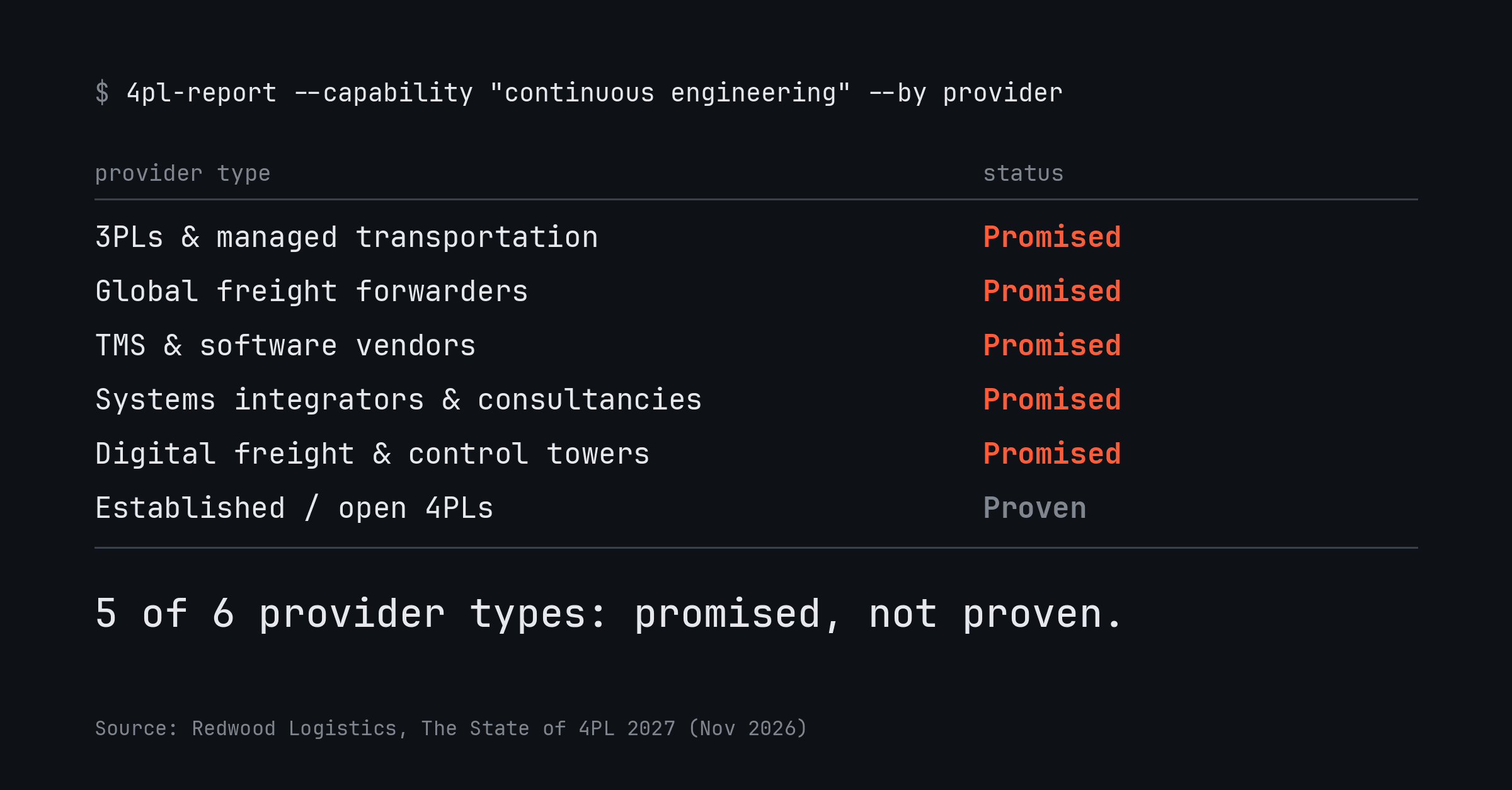
Second, every provider converging on 4PL has the same gap. The report scores six provider types (3PLs and managed transportation, forwarders, TMS vendors, systems integrators, digital freight platforms, established 4PLs) across eight capabilities. On "continuous engineering," every category except the established 4PLs is marked Promised, not Proven. That's the honest assessment of the field, and it's correct.
Third, buyers are being told to screen for it. Warning Sign 7 on their list of reasons to slow a selection process: no dedicated continuous-engineering resources or measurable improvement backlog. Prediction 7: continuous engineering replaces the annual optimization project, and the early indicator is engagements staffed with permanent engineers rather than periodic consulting teams.
Put those together. Your customers are going to ask what changed in their network last quarter because of you, and they're going to ask who on your team is responsible for the answer.
What "standing engineering function" means at a 200-person broker
Redwood can say this because about half of their 1,000-plus associates build and run technology, and their integration platform connects 150-plus products. Most providers reading this don't have that and can't afford to build it the way Redwood did.
So let me describe the minimum viable version, because I've built it inside two freight companies this year.
It is not a platform team. It is one to three senior engineers who own a backlog that never closes. The backlog has three kinds of work on it:
-
Connectivity. The next carrier API, the next customer's EDI 204/214/210 set, the next visibility feed. Redwood's number is 0.8 new systems per client per year; a broker with forty active shipper accounts is looking at thirty-plus integration changes a year on the shipper side alone, before carriers.
-
Exception retirement. The report notes that a handful of reason codes drive most exception volume. Each one an engineer retires (a bad address format, a missing appointment field, a settlement mismatch) removes a recurring cost, not a single incident. This is the work that makes the "what changed last quarter" question answerable.
-
AI foundations. Redwood's own research found only 13% of shippers deploying AI are getting quantifiable results, and the barrier is data quality and integration, not models. Agents that act need normalized data and written decision thresholds. Somebody has to build those first. That's engineering, not a vendor purchase.
The function has a cadence (we run a weekly backlog review with the ops lead) and a measurement (what got retired, what got connected, what the exception count did). That's it. No transformation program.
What it costs, honestly
A senior US platform engineer runs $180K to $220K fully loaded, and in this market you'll wait three to five months to hire one. Two of them is a half-million-dollar line item before they've shipped anything, which is why most providers' continuous-engineering column says Promised.
What we do at NKE: senior nearshore engineers from Colombia, working your hours, embedded in your team, running your repo and your standups. Month-to-month. You interview the engineer before anything is signed. Rates are published. The engineers work alongside our agent fleet, which means the connectivity backlog moves faster than a human-only team, but the human owns the result and the agent's self-assessment is treated as marketing.
I'll say plainly what the report warns about: a nearshore engineer doing manual rekeying is labor arbitrage, and labor arbitrage doesn't compound. The test is whether the backlog shrinks. If your engineer is retiring causes and connecting systems, you're building a function. If they're clearing queues, you're renting hands.
A concrete offer
Redwood's readiness scorecard has a row for continuous engineering: one point for annual re-optimization, two for episodic tweaks, three for a standing backlog that keeps re-architecting the network. Most providers I talk to score a one and describe themselves as a three.
If you want to know where you actually sit, I'll do an integration-backlog audit with you: thirty minutes with your ops lead, a list of what's connected, what's manual, and which exceptions recur.
What's on your backlog right now that nobody owns?