133 ELDs just got revoked. Your carrier data feeds didn't get the memo.
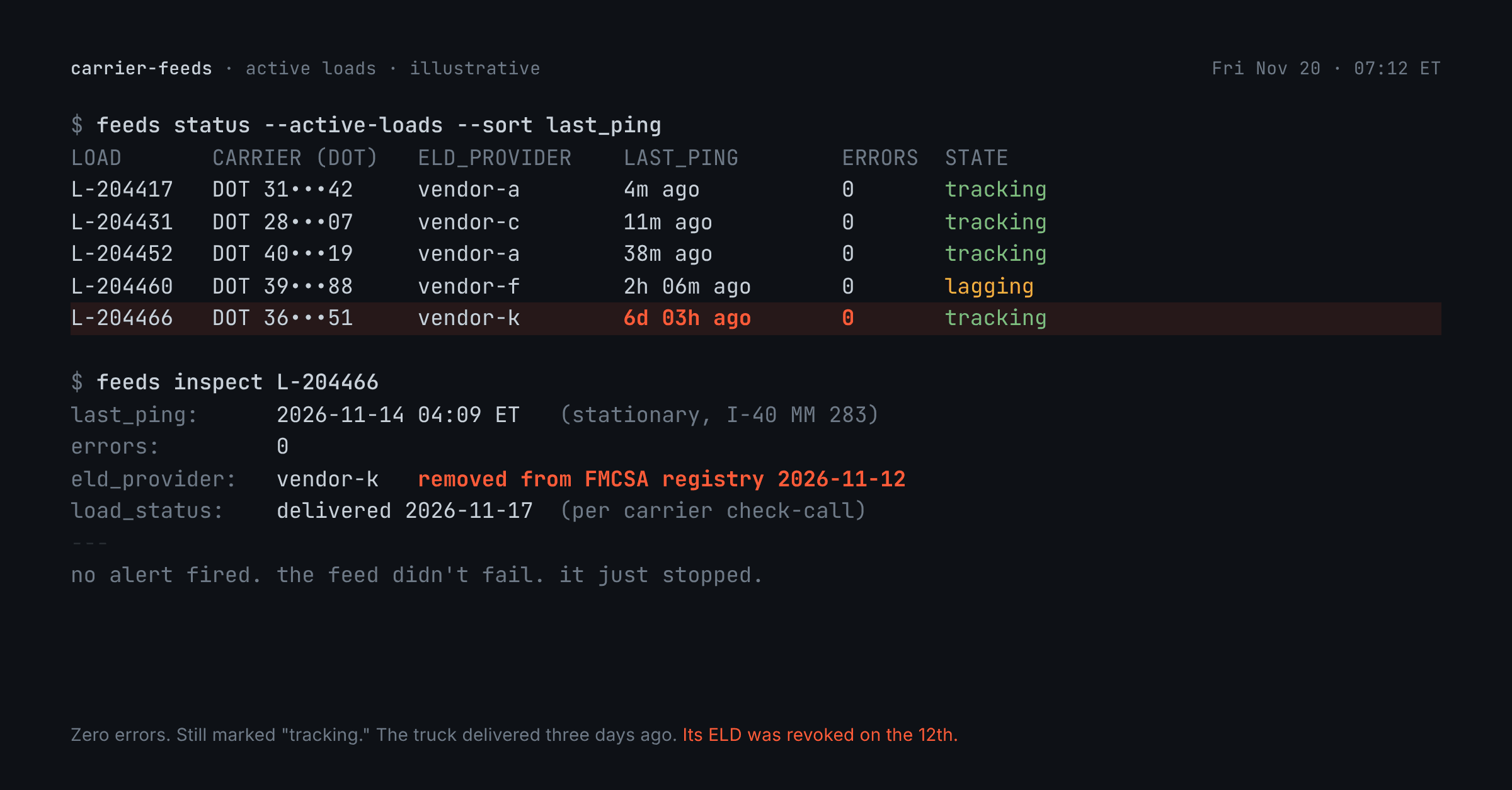
On November 12, FMCSA removed 133 electronic logging devices from its registry. DOT called it the largest ELD revocation in the agency's history: 121 devices revoked for failing the minimum federal requirements, 12 pulled voluntarily by their providers. The agency cited evidence that some of them made it easy to falsify hours-of-service records. That brings the total to nearly 230 removals in about a year since FMCSA stopped letting providers self-certify.
Carriers get up to 60 days to replace a revoked device. But enforcement guidance tells officers that a driver found running a revoked ELD on or after November 24 should be cited and placed out of service. That's tomorrow!
Most of the coverage so far is written for carriers: check the list, buy a registered device, export your records before you close the old account. All correct. Do that.
I want to write about the part nobody is covering, which is what happens downstream.
An ELD is also a data source
An ELD isn't just a compliance box. It's the most reliable location and status signal a carrier produces, and a lot of the industry has wired itself to it.
Brokers pull ELD location for load tracking. Visibility platforms connect to ELD providers so shippers get ETAs. Insurers and factoring companies use telematics to underwrite and to spot fraud. In most of these setups the connection is to a specific ELD provider, authorized by the carrier, keyed to that provider's identifiers.
Before NKE I worked at project44, where carrier telematics feeds were the product. The lesson from that work holds here: the feed is only as stable as the device and the provider behind it.
So when a carrier swaps ELDs under deadline, here's what goes with the old device:
- The connection. A new provider means new credentials, a new authorization from the carrier, and often a new integration path entirely.
- The identifiers. Vehicle and device IDs change. If your system keys on them, the truck you were tracking no longer exists, as far as your system knows.
- The history. The carrier is told to export its logs. Nobody exports your copy of the location history or the mapping that tied it to your loads.
The failure is silent
None of that throws an error. A stale feed doesn't look broken. It looks like a truck that hasn't moved.
In practice it goes like this. A load goes dark. A dispatcher calls the driver. Ops marks it as a carrier issue. Three weeks later someone notices that one carrier's tracking has been manual since mid-November and opens a ticket. The ticket sits behind everything else, because nobody owns integration maintenance.
Now multiply it. Many of the names on the revoked list are low-cost phone-app ELDs. The fleets running them are mostly small carriers, and small carriers are most of the capacity a broker books. If you have a few thousand active carriers, some of them are on that list. You probably don't know which ones.
One check before you assume you're exposed: plenty of small carriers are tracked through driver apps rather than ELD integrations. Find out which of your feeds actually come from an ELD. That's the list that matters here.
What I'd do this week
None of this needs a project. It needs someone to spend a few days on it.
- Find out who's affected. Cross-reference your active carriers' ELD providers against the removed list. If you don't capture ELD provider at onboarding, that's the first finding. Add the field.
- Alert on silence, not on errors. Set a staleness threshold per carrier feed, not per load. A feed with no pings in 12 hours on an active load is an incident, not a dispatcher's problem.
- Build the re-onboarding path. When a carrier switches providers, there should be a known, fast way to re-authorize the new feed and remap identifiers. Ideally the carrier triggers it themselves.
- Key on the carrier, not the device. Tie history to the DOT number and your load IDs, so a device swap doesn't orphan the record.
The fraud angle belongs to you too
The ATA published six recommendations last week for tightening ELD integrity. The first is running checks on electronic logs for common indicators of fraud. That's aimed at regulators and ELD providers, but brokers hold the other half of the evidence: GPS pings, appointment times, check-call history. A truck that covered 400 miles in four hours shows up in your data, not just in the driver's log.
Somebody has to write that check, run it, and look at what it flags. Same as the four items above. It's the same point I made last week about the standing engineering function: the work never makes a roadmap and never stops arriving. Regulatory events like this one just make it visible.
That's the work NKE does. We place senior nearshore engineers who work your hours, in your repo, month-to-month. You interview the engineer before anything is signed. Ownership of a backlog like this is exactly the job.
What does your team do today when a carrier's tracking feed goes quiet?